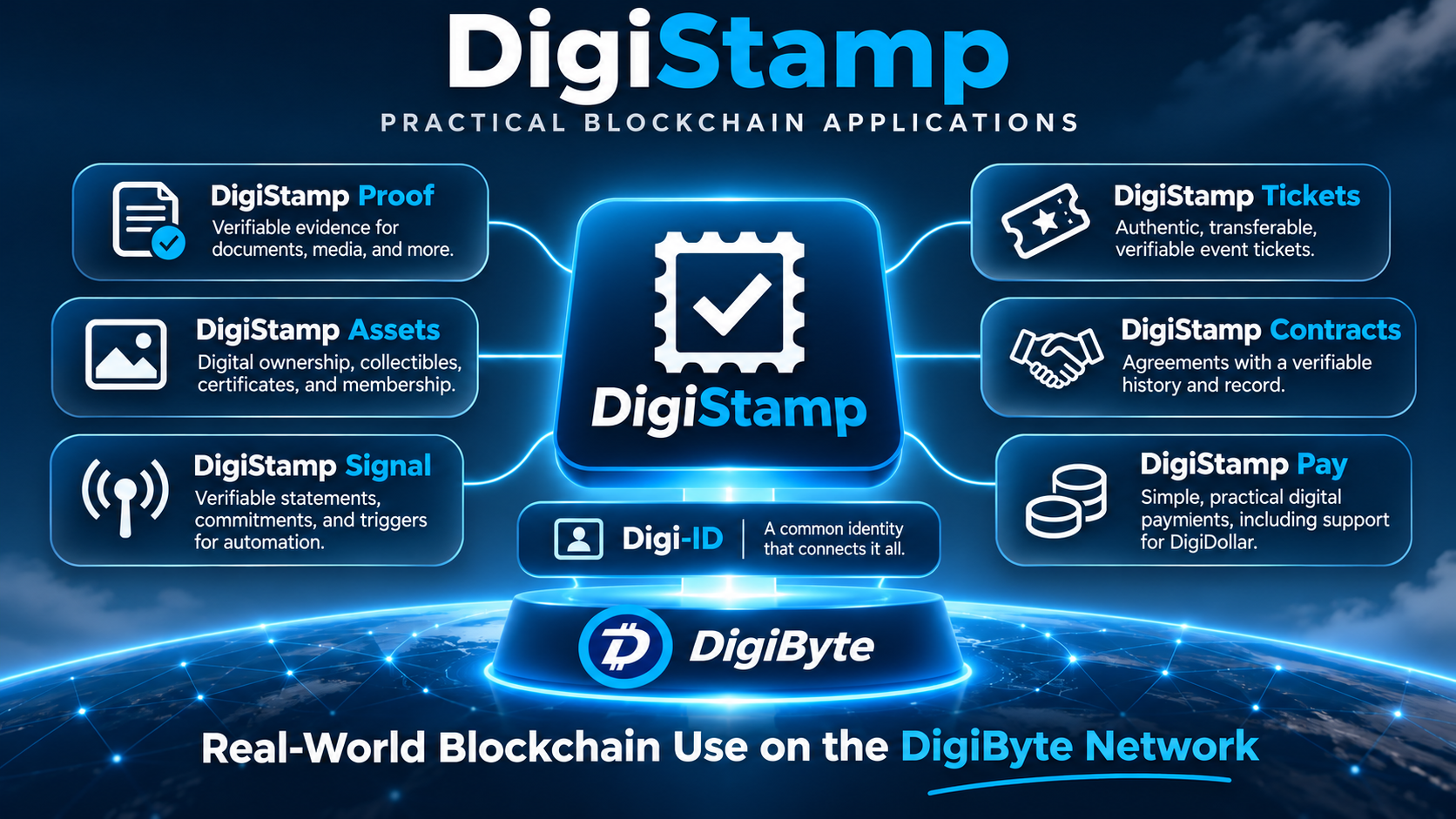
I have spent a considerable portion of my life working with technology, and one of the things that has always fascinated me is the difference between what technology is capable of doing and what people actually use it for. Cryptocurrency is probably one of the greatest examples of that disconnect. We have spent years talking about price, market capitalization, exchanges, adoption, and when the next bull run is going to happen. Meanwhile, some of the most interesting capabilities of the underlying technology remain relatively unexplored. At some point, I started asking myself a different question. What if we stopped talking about what a blockchain could do and actually started building things that did it?
That is a large part of the motivation behind DigiStamp.
DigiStamp wasn’t born out of a desire to create another cryptocurrency, launch another token, raise money, or convince people that something I created was going to make them rich. Frankly, I think we have enough of that in this industry. What interested me was taking an existing blockchain, DigiByte, and building practical applications around it. I wanted to explore what could be accomplished with technology that already exists rather than inventing another blockchain to solve problems that existing technology may already be capable of solving.
One of my frustrations with the cryptocurrency community, including the DigiByte community, is that we frequently talk about adoption without really defining what adoption looks like. Getting listed on another exchange is great. Having more wallets available is great. Having more people own DigiByte is great. But owning something and actually using it are two entirely different things. I can own a hammer for twenty years, but until I drive a nail with it, I haven’t really demonstrated its usefulness.
I want to drive some damn nails.
DigiStamp is essentially becoming my laboratory for exploring these ideas. Each application within the platform is an attempt to answer a relatively simple question about how blockchain technology might solve a real-world problem. Some of those ideas may turn into something substantial. Others may prove to be interesting experiments that never gain widespread adoption. I’m perfectly comfortable with either outcome because there is value in discovering what works and what doesn’t.
DigiStamp Proof explores the concept of independently verifiable digital evidence. What if you could establish that a particular document, photograph, statement, or piece of intellectual property existed at a particular point in time? What if someone could independently verify that the material presented to them matches what was originally recorded? You don’t necessarily need to put someone’s entire document on a blockchain. You can use its digital fingerprint to establish evidence without publicly exposing the contents. Think about the possibilities for business records, journalism, intellectual property, photography, contracts, and even personal records.
DigiStamp Assets explores digital ownership and collectibles. Unfortunately, the NFT craze managed to convince a significant portion of the population that digital assets were little more than overpriced pictures of monkeys. That is a shame because the underlying concept is considerably more interesting. Digital collectibles, certificates, limited editions, memberships, licensing, and items with independently verifiable histories all represent potential applications. The artwork might be the fun part, but the technology behind establishing its authenticity and tracking its history is what really interests me.
DigiStamp Signal is another experiment that I find particularly interesting. What if a person, organization, or application could publish a verifiable statement, declaration, commitment, or signal that could subsequently be referenced by another person or system? Could that signal eventually trigger another process? Could it be used to establish a commitment before an event occurs or coordinate the timed release of information? There are interesting possibilities when you start combining verifiable information with automation. I suspect we haven’t even scratched the surface of what this particular concept could become.
DigiStamp Tickets takes something that most people already understand and looks at it from a different perspective. Why shouldn’t a ticket have an independently verifiable history? Why couldn’t an event organizer issue digital tickets with mechanisms to establish their authenticity, ownership, transfer, and redemption? The interesting part is that the person attending the event shouldn’t need to understand blockchain technology to benefit from it.
DigiStamp Contracts explores how blockchain technology can complement agreements between people and organizations. I’m not suggesting that putting something on a blockchain magically makes it legally enforceable or eliminates the need for attorneys. However, establishing evidence of an agreement, its contents, its revisions, and the events surrounding it could have considerable practical value. Having a record that doesn’t depend entirely on one company’s database is an interesting proposition.
DigiStamp Pay is another area I am working toward because, at the end of the day, cryptocurrency should probably be capable of functioning as currency. I want to explore how individuals and businesses can accept digital payments without turning the experience into an unnecessarily complicated technical exercise. The emergence of DigiDollar also introduces some interesting possibilities for people who want to transact without necessarily being exposed to the same price volatility associated with traditional cryptocurrencies.
Then there is Digi-ID, which introduces another piece of the puzzle. Rather than treating every application as an entirely separate experience, why not explore how a common cryptographic identity can connect these services? The more I work on DigiStamp, the more I see opportunities for these individual applications to complement one another. A payment could be associated with an agreement. An agreement could have independently verifiable evidence. A digital asset could represent a ticket or certificate. A signal could initiate another application-level process. Suddenly, these aren’t just a bunch of independent websites. They start becoming pieces of a larger ecosystem.
There is also a philosophy behind all of this that comes from my years working in enterprise technology. Good technology should eliminate complexity for the person using it. It shouldn’t require them to become an expert in the underlying infrastructure. Nobody needs to understand the inner workings of TCP/IP to send an email, and nobody should need to understand cryptographic hashing, transaction confirmations, or blockchain architecture to prove that a document existed. If blockchain technology is ever going to become genuinely mainstream, I suspect its greatest successes will involve people using it without necessarily realizing they are using it.
That is the direction I would like to take DigiStamp.
I’m also deliberately building much of this in public. Things will change. Things will break. Ideas that sounded brilliant at two o’clock in the morning may turn out to be absolutely stupid the following afternoon. That’s part of building something. I’ve spent enough years in technology to understand that you rarely end up with exactly what you originally envisioned, and sometimes the best ideas are the ones that emerge from actually using what you’ve built.
I’m not particularly interested in building something simply to impress the existing cryptocurrency community. I would much rather build something that is useful to a person who has absolutely no interest in cryptocurrency. If a photographer can establish evidence of when an original work existed, a small business can accept a payment, an event organizer can issue a verifiable ticket, or someone can independently verify a document without caring what blockchain made it possible, then I think we have accomplished something far more interesting.
People occasionally ask me why I spend so much time working on these things. At this point in my life, I could probably find considerably easier ways to occupy my time. But I’ve never been particularly good at ignoring my curiosity. I enjoy building things. I enjoy figuring out how technology can be used in ways that weren’t necessarily envisioned when it was created. And I genuinely enjoy taking an idea that exists in my head and turning it into something that another human being can actually use.
I don’t know exactly what DigiStamp will ultimately become. That’s part of what makes it interesting to me. There is no requirement that every experiment become a successful business, and there is no promise that every idea will change the world. But I’d rather spend my time building something and discovering its potential than spend another decade talking about the potential of something nobody bothers to build.
Perhaps the greatest contribution we can make to DigiByte isn’t convincing another thousand people to buy it.
Perhaps it’s giving another thousand people a reason to use it.
That’s what I’m trying to do with DigiStamp.