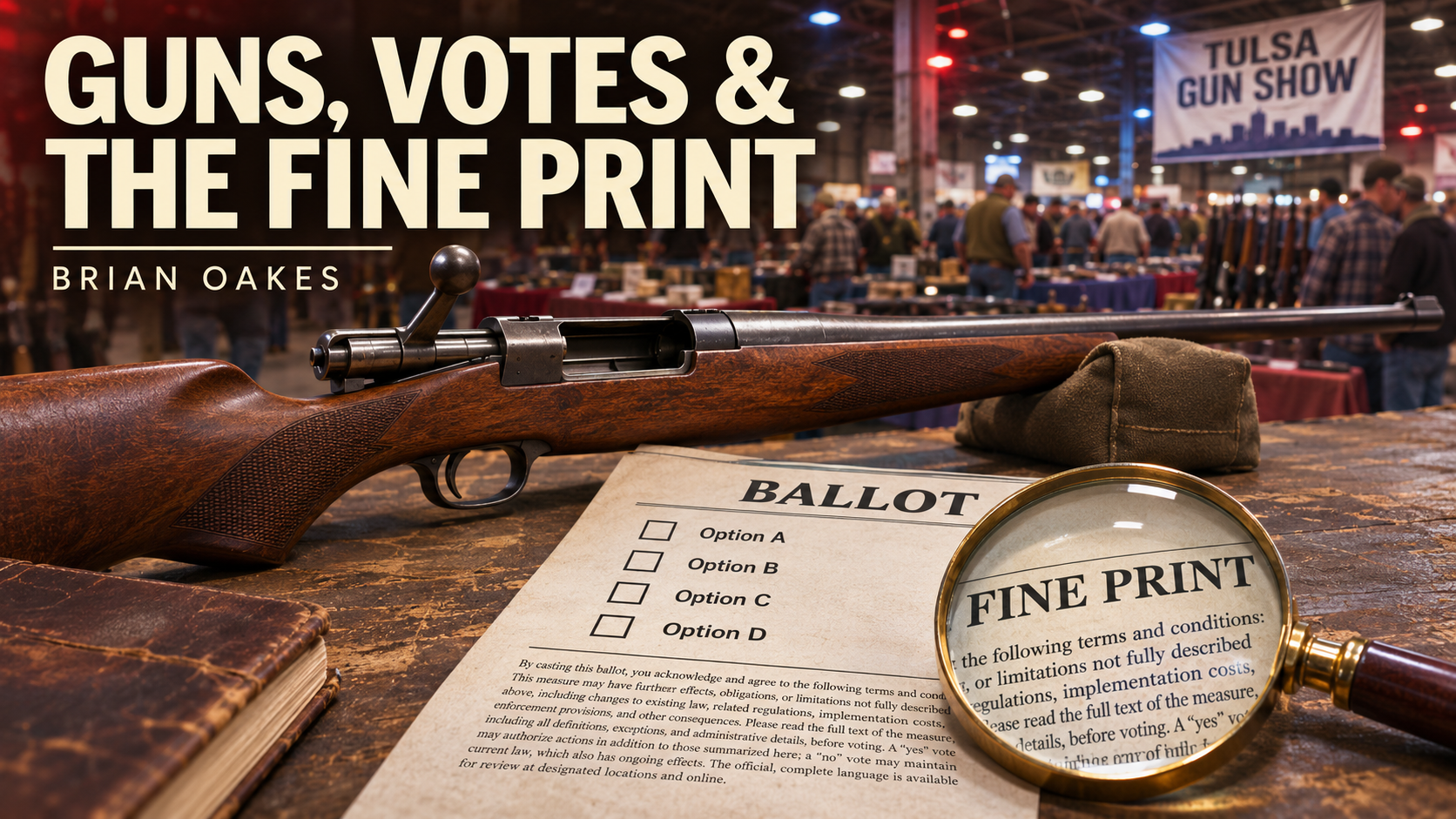
Long story, but I ended up taking my father to a gun show in Tulsa. Supposedly one of the largest in the world, and after walking around it, I can believe it. Pretty impressive. There’s casually looking at guns, and then there’s realizing you’ve covered enough ground to justify a meal you probably shouldn’t eat. Somewhere between the tables and the walking, something caught my attention that had nothing to do with what was for sale.
I noticed people whose shirts, buttons, or other political messaging suggested they were Democrats. Definitely a minority at this particular gathering, at least from what I could see, but there they were, enjoying the same show as everyone else. I wasn’t checking voter registrations next to the ammunition, so these were impressions, not polling data. Still, it got me thinking about the tension between valuing a freedom and supporting politicians who want to restrict how you exercise it.
Being a Democrat and owning a gun shouldn’t be surprising. The Second Amendment doesn’t require a Republican voter registration card. You can be liberal, enjoy shooting, own firearms, and believe strongly in your right to defend yourself. Frankly, seeing people with different political views sharing an interest was refreshing. We could use more of that. But it also raises a reasonable question about what happens when that shared interest runs into the policies of the people you help elect.
The Democratic Party’s 2024 platform called for universal background checks and bans on assault weapons and high-capacity magazines. That doesn’t mean every Democrat wants to confiscate every firearm. But these are actual proposals affecting what people can buy and own. Walking through a building filled with firearms, accessories, and people enjoying the ability to purchase them makes that policy debate feel considerably less abstract.
I already know the response: “Brian, I care about more than guns.” Fair enough. So do I. Nobody walking around that show owed me an explanation of their entire political philosophy, and I certainly wasn’t about to start demanding one. People vote based on the economy, health care, abortion, immigration, character, and everything else that comes with trying to keep a country functioning. Nobody gets to order a candidate with everything they want and hold the bullshit. But accepting a compromise means acknowledging what you’re compromising.
There’s a meaningful difference between saying, “I disagree with their gun policies, but other issues matter more to me,” and saying, “They won’t actually do that.” One is an honest explanation of your priorities. The other is betting a freedom you care about on the hope that a politician won’t follow through. We spend plenty of time complaining that politicians never keep their promises. Apparently, sometimes our entire voting strategy depends on it.
In IT, if a vendor tells me the next version removes a feature my business depends on, I don’t renew the contract and assume they’re kidding. I ask questions and figure out whether I can live with the consequences. “I really like the company” doesn’t restore the feature after the update. That was the thought following me around Tulsa: how many of us read the specifications on something we’re buying more carefully than the platform of someone we’re electing?
There’s also a difference between enjoying gun ownership and defending the right itself. In a show that size, you’re going to see things you’d like to own, things you can’t afford, and things you have absolutely no use for. That last category matters. “I don’t need one” is a perfectly reasonable purchasing decision. Turning it into “therefore nobody else should have one” requires a much stronger argument. My personal shopping list shouldn’t determine the limits of someone else’s rights.
To be fair, someone can believe certain firearm restrictions are compatible with the Second Amendment. That’s a real disagreement, and it deserves a conversation about the proposal, its limits, and what it accomplishes. The people I noticed at the show may have had thoughtful answers to every question I’m raising. Their appearance didn’t tell me their position on a particular bill. What it did was remind me that gun owners aren’t a single political bloc, even when campaign messaging makes them sound like one.
So maybe this comes back to choosing the lesser of two evils. I understand that calculation, but the phrase needs to come with some personal responsibility. Your vote helps put the whole candidate in office, including the positions you wish came in a separate package. If you decide the tradeoff is worth it, own that decision. Don’t act blindsided when the person you supported starts working on something they explicitly promised to pursue.
And this reaches beyond Democrats and guns. Every party has voters explaining away something they would be furious about if the other side proposed it. I’m not exempt from having to examine my own choices. Walking around with my father gave me plenty of time to think, and the useful question eventually became bigger than the people whose political messaging I’d noticed. What am I willing to excuse because I like the person, dislike the alternative, or have gotten too comfortable defending my own side?
I enjoyed the show, and I liked that people with different views could be there enjoying it together. I’d like to see that same willingness to share a room carry over into asking each other honest questions. If a freedom matters to you, your own candidate should expect to hear about it. Party loyalty shouldn’t buy anyone a pass, and choosing the lesser of two evils shouldn’t mean putting your common sense back in the truck.
